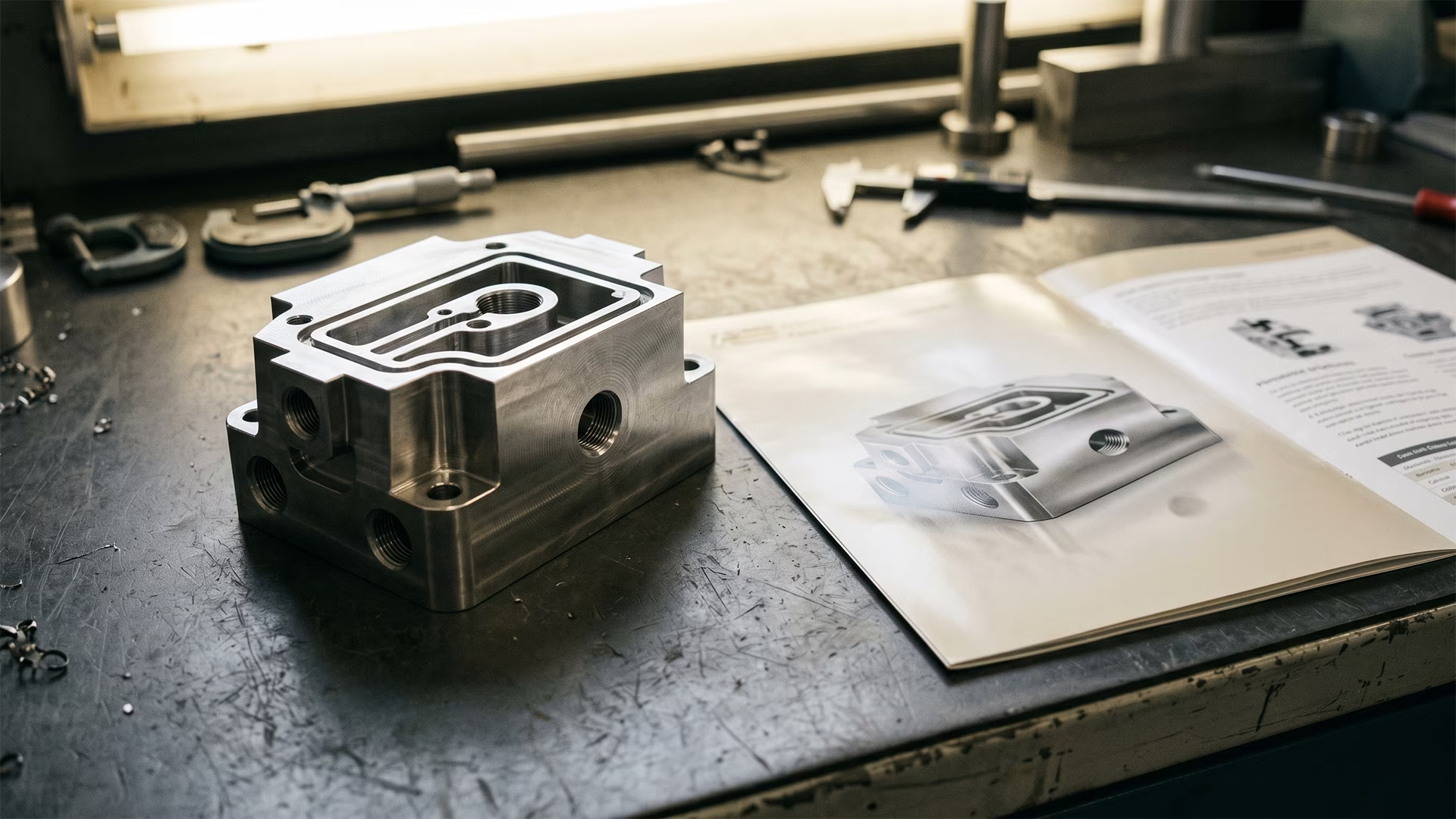
A brochure informs; an evidence pack qualifies
A capability statement is not a brochure. It is a proposal evidence pack. Understanding that distinction and applying the appropriate treatment will decide whether your document clears RFP shortlisting or gets set aside. The same evidence standard carries into tender response and proposal writing.
A brochure describes what your technology can do. Conversely, an evidence pack proves what it has already done, for whom, at what scale, and what changed as a result. A Procurement Manager will find value in the second one and will rarely finish the first.
At its inception, a company founder will typically brief a designer for a document that explains the product, because the product is what they know best, so the page fills with services, features, and certifications. However, a proposal evaluator is not looking for a listicle. They are looking for evidence of both capability and credibility. Curiously, the gap between these two is often where capable firms get filtered out.
This is where the ‘we just need something basic for now’ instinct costs money. Basic feels prudent when cash is thin, and the opportunity is moving fast. Nonetheless, the document does commercial work whether you treat it seriously or not. A thin capability statement does not sit harmlessly in an inbox. It files your firm under unproven, and the cost is the pre-qualification you did not pass and the shortlist you never saw.
The same gate operates in resources, where mining capability statements face an identical evidence test.
A weak capability statement is a brochure. A strong one is an evidence pack.
What proposal evaluators look for, and what they don't
Although a buyer requesting a proposal will evaluate your technology, they will also assess your firm's delivery risk. That distinction is often missed because the vendor’s technical focus and the buyer's purchasing rubric look like different things.
The statement, “Our technology speaks for itself,” is highly effective during a product demo. But in a proposal, the lens shifts.
Even if the person evaluating your bid is a Lead Engineer or a Plant Manager, they are no longer just looking at features. They are looking for evidence that choosing you will not become a liability: financially, operationally, or on delivery. They need commercial proof to defend their recommendation to the rest of their operation.
Simply put, your unverified claims of technical superiority may be perceived as ‘marketing’ rather than a quantified advantage.
The criteria a buyer scores against are usually narrow and consistent:
- Delivery history at a comparable scale
- Financial capacity to carry the contract
- Evidence the technology has run in a live environment, not just a demo
- Support and continuity if something fails at 2am on a critical asset
- A robust compliance and security posture that de-risks operations
None of those criteria is about how clever the product is. All of it is about whether the firm behind it can be trusted with the job.
So, the structure to build your case is not about ‘what our technology does’, but rather ‘what does this evaluator need to confirm before they can confidently defend choosing us’? Answer that, and the document starts doing the heavy lifting the brochure never could.
Your technology speaks to engineers. Procurement needs commercial proof, in the order an evaluator scores it, so your case lands where it counts.
Five sections an industrial tech document must prove
Knowing what criteria a buyer typically scores against is not the same as knowing what your document must contain. The rubric is the evaluator's lens; the structure is your answer to it.
A document that survives evaluation is built from a small number of sections, each carrying its own burden of proof. Order matters as much as content: a prospect will scan the document front-to-back and stop when they have seen enough to decide.
In most circumstances, the following five sections will do the load-bearing work:
- Commercial positioning. Proves you understand the buyer's problem and where you fit, not where the company came from. Lead here, not with the founding story.
- Capability and deployment evidence. Proves the technology has run in a live environment at scale, with named or anonymised deployments, conditions, and duration. A demo is not a deployment.
- Quantified outcomes. Proves what changed for the client in numbers procurement can verify: downtime avoided, cost removed, throughput gained, assets brought under monitoring.
- Risk, security and continuity. Proves you reduce the buyer's exposure to include: security posture, where the work touches operational technology, current-revision certifications, support model, and continuity if the firm or the platform fails.
- Commercial and operational standing. Proves the firm can carry the contract: financial capacity, team depth, comparable references, insurance to project tier.
Most industrial tech documents over-invest in section two and under-invest in three and four. The product gets pages; the commercial outcome and the risk picture each get a paragraph. However, that approach is backwards. The evaluator already assumes the technology works, or you would not have been invited to submit. What they cannot yet see is whether choosing you is safe.
Most tech documents over-prove the product and under-prove the risk. Procurement decides on the second one.
Turning technical claims into evidence that buyers can verify
Every technical claim in a capability statement has a commercial translation, and the firms that get shortlisted do the translating before the evaluator has to. A claim left in engineering language asks the reader to work out the value for themselves. Many buyers will not do that work. They will move to the next supplier who has already done it for them.
The pattern is simple once you look for it. Engineering specifications translate into operational outcomes a buyer can picture. Certifications translate into proof that someone whose judgement matters has tested and accepted the claim. Specification or certification, the move is the same:
Example 1 (performance spec → operational outcome)
- From specification: ‘Our technology has a sub-50ms response time’
- To evidence: ‘Our technology caught a developing pump bearing fault days before it would have stopped the line, preventing a three-shift plant shutdown’.
Example 2 (certification → proof of acceptance)
- Certification: ‘IEC 62443 compliant’
- Proof: ‘Cleared a Tier-1 utility's independent cyber assessment without remediation and was approved to connect to their plant control systems’.
As a helpful tip: The translation always runs in the same direction: from what the technology is, to what it changed, to what that is worth to a buyer carrying the operational exposure (more simply, what core problem it solves - for the buyer specifically)
Here are some further examples:
- ‘Latency’ becomes ‘avoided downtime’.
- ‘Accuracy’ becomes ‘fewer false call-outs and lower maintenance cost’.
- ‘Integration depth’ becomes ‘a shorter commissioning window and less disruption to a running plant’.
The specification earns its place only when it is tied to the consequence.
This translation layer is also where verifiability matters more than ambition. A number an evaluator can check, even a modest one, outperforms a bold claim they cannot. So, where possible, name the deployment. Anonymise the client but retain the operational specifics. The evidence value lives in the specifics, not in the size of the assertion.
A specification asks the evaluator to do the thinking. Translation does it for them, and evidence proves the claim.
Build the argument first, then design the document
Many capability statements are built backwards. Firms write copy, lay it out, slot in some product pictures, add a few grainy headshots of the senior team, factor in their vision, mission and values statement and hope it all holds together.
Order matters as much as the inputs
While the substance is critical, the chronological structure of the document matters equally. The work has an order, and each step takes its instruction from the one before.
Consider the following structure as an example: a clear diagnosis (the challenges your target market faces), distinct positioning (your unique solution to those challenges), and specific evidence (whether that be case studies, testimonials, or a combination). It is only after that structure is embedded that we get to the brand, design and imagery. Reverse the order, and you spend longer and finish weaker.
Take, for example, the firm in our electrical engineering marketing case study: a 26-year-old business with over 150 staff, a strong track record, but weak collateral materials. When I structured the work in the right sequence, the entire brand refresh, 20-page capability statement and website came together quickly. The key was doing things in the proper order, naturally compressing the delivery timeline and producing a commercially robust result.
A pretty document won't cut it
Regardless of how well-designed a document is aesthetically, the polish will never compensate for an unclear argument. It is the substance that decides whether it survives the first scan.
A potential buyer reads past the styling to ascertain the underlying logic: does the firm understand my problem, has it proven what it claims, and can it carry the operational weight? Get the foundation right, and the design earns its place.
Good design doesn't equal a good document. Substance is what wins the deals.
Audit your capability statement before a buyer does
To reiterate everything that we've covered in this article, the outcome of a capability statement is to clearly articulate credibility and capability - for the benefit of the buyer.
While the term may well be a cliché, a capability statement truly is a customer-centric document. To assess how buyer-focused the document is, take a moment to run an audit. Examine it critically as a prospective buyer would. Look for reasons to set it aside rather than reasons to admire it.
Ask these questions:
- Does the first page prove you understand the buyer's risk, or does it introduce your company and what you do?
- Is there a range of quantified outcomes an evaluator could verify, or only descriptions of capability?
- Does the technology section (what you are selling) show a live deployment, or is it just a demo dressed up as one?
- If the work touches their operational systems, is the security and continuity picture addressed, or vague?
- Does the document reflect the firm you are now, or the firm you were three years and two service lines ago?
If the honest answer to most of those is the wrong side of the line, the document is filtering you out before evaluation begins. That is not a design problem. It is a proof problem, and proof problems are fixable once you stop writing the document for yourself and start building it for the evaluation.
Read your capability statement as an evaluator looking for a reason to disregard it.
FAQs
Long enough to prove the claims, short enough to scan. For most industrial tech firms, that is eight to fourteen pages: positioning, deployment evidence, outcomes, risk and continuity, and commercial standing. If the buyer specifies a format or page limit, that overrides any general guideline. Confirm their requirements before you build to length.
Yes. Lead on what you have and treat it forensically with scale, environment, instrumentation, and third-party validation.
The depth of what you can show beats the count. Where possible, invest in proof sections that do not depend on deployment volume, particularly pilot outcomes, risk, and continuity. Procurement is not blind to early-stage firms it can verify.
No. A pitch deck sells a vision to investors or early prospects. A capability statement gives a potential buyer the structured evidence needed to qualify you without a meeting. One persuades; the other proves. Sending a pitch-deck into a proposal process signals you have misread what the evaluator is there to do.
At least once a year, and immediately after anything material: a new deployment, a major contract, updated certifications, a security accreditation, a funding round, or a shift in target tier. In industrial tech the proof set dates fast. An outdated document understates the firm and quietly filters you out of work you could win.
Key Takeaways
- A capability statement is a procurement evidence pack, not a product brochure. ‘Something basic for now’ is a false saving: a thin document files your firm under unproven and costs you shortlists.
- Buyers evaluate your firm as a delivery risk, not just your technological merits.
- Five sections carry the load: commercial positioning, deployment evidence, quantified outcomes, risk and continuity, and commercial standing. Most industrial tech documents over-prove the product and under-prove the risk.
- Translate every technical claim into evidence a buyer can verify. A modest number an evaluator can check beats a bold claim they cannot.
- The build runs in sequence: diagnose, position, structure, then design. Polish never compensates for an unclear argument; substance is what survives the first scan.
- Audit your own document as an evaluator hunting for reasons to set it aside.