
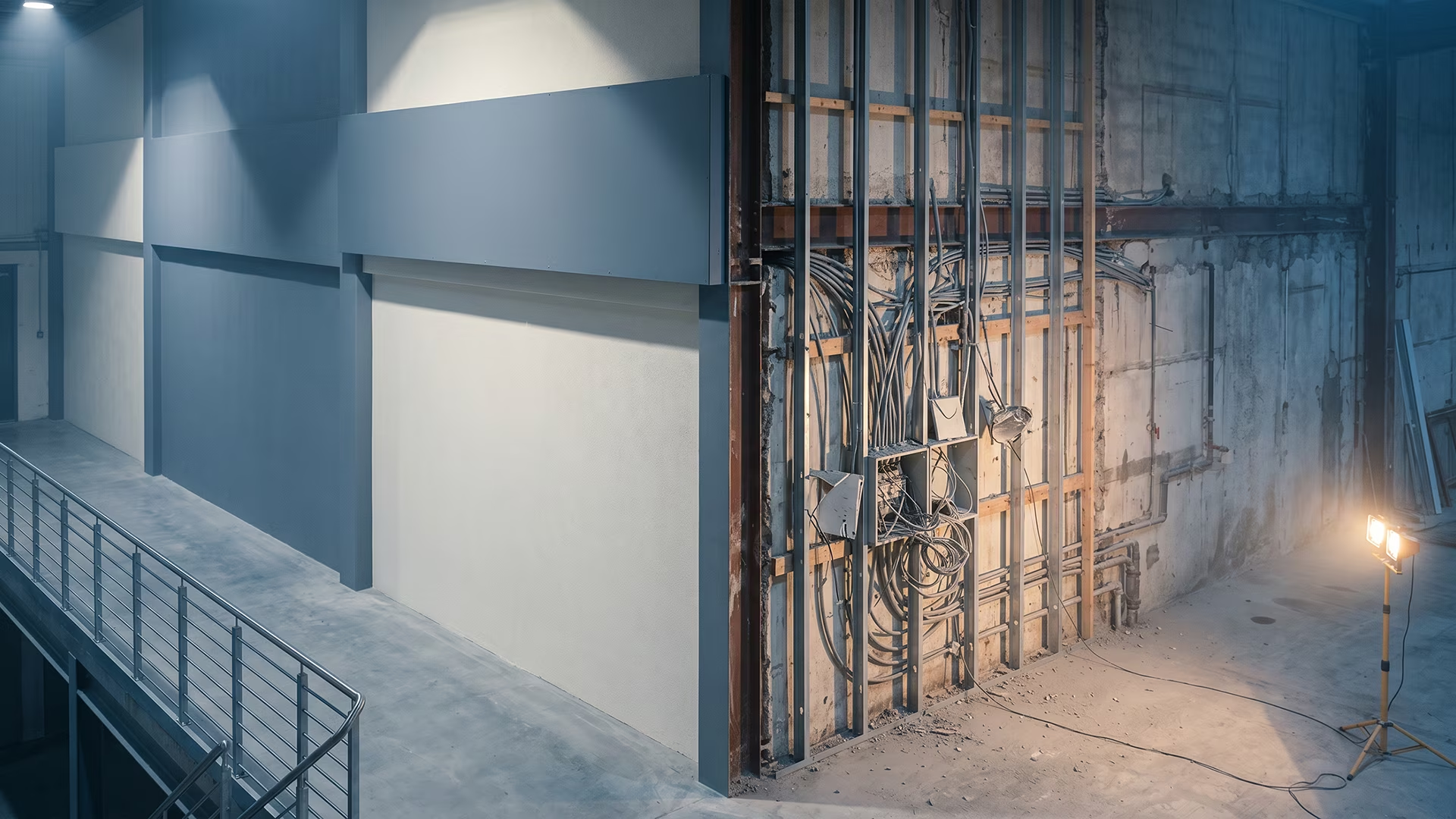
What's usually behind an industrial website request
The initial discovery call I receive usually starts with an urgent request: a brand-new industrial website or comprehensive overhaul. From the stakeholders' perspective, the underpinning desire is to project a cleaner, more professional image out into the market.
Before we discuss scope, site maps, or design files, I ask a few diagnostic questions:
- How are you generating qualified opportunities right now, and how many of those channels do you control?
- What do you think a prospective client sees from the moment they hear your name to the moment they sign?
- How are you positioned against the two or three competitors you keep coming across in the market?
What emerges from those questions is rarely an industrial website design problem. Most of the time, the firm has grown through relationships and referrals and cannot reliably convert through any other channel.
Sometimes the founder still holds the commercial intelligence in their head, and almost none of it is documented anywhere a buyer can easily find it.
Almost always, it is a business that does excellent, market-leading work but presents itself in language that reads the same as that of a dozen other METS and industrial firms.
Typically in marketing, we call that scenario a positioning and differentiation gap and the website is where that gap is most evident. It is the public face, so it takes the blame. But painting over a visible symptom does not fix the underlying system, and the firms that treat the site as the whole job tend to find themselves in 12 months with the same complaint.
A rebrand that doesn't change how you go to market is a very expensive coat of paint.
The three things I often uncover
When we dig past the brief, at least one of the following three elements is true, and at times, all three.
1. The positioning is ill-defined
Often, a firm can list its services without pause, but it struggles to explain why a buyer should choose it over the competition. Instead, what we see are classic generic phrases in a firm's collateral, such as: 'Quality work, delivered safely and on time' or 'Your success is our focus'.
While those taglines may have sounded exciting when they were coined in a company meeting, they are baseline expectations, not a market position. Almost every competitor is going to claim something with a similar flavour - if not the same.
More simply, without defensible differentiation, a new website asks a designer to window-dress a generic message in a nicer typeface.
2. The technical edge has no paper-trail
The firm holds a genuine technical lead over its competitors, but the evidence was never documented clearly or structured for a cold buying audience.
That scenario means there are no before-and-after metrics, no structured B2B case studies, and no client references cleared for immediate use. The wins are completely factual, and the leadership team knows the operational details by heart. But because that data exists only verbally, a prospective buyer cannot analyse it without first booking a meeting.
3. The commercial system is fragmented
In this instance, sales conversations, marketing collateral, tender submissions, and the website were each built at different times, by different people, in response to different pressures. They do not reference one another, nor do they tell a unified story.
That fragmentation creates a disconnect for a prospective client. A founder might deliver a flawless, high-level pitch in a boardroom based on decades of relationships. Still, when a procurement manager reviews the capability statement or visits the website later, they encounter an entirely different business. The narrative shifts, the focus blurs, and the market presence suddenly no longer looks Tier 1-ready.
A new website built on top of that shaky foundation puts the disconnect under a spotlight and renders it in higher resolution.
Five questions that reveal the underlying commercial problem
If your leadership team is drafting a website brief for a designer or agency, run through this quick triage matrix first. It will immediately show whether you are ready for a design project, or if you have a deeper positioning job to tackle first.
How to interpret your results
The Rule of Thumb: If you answered 'No' to two or more of these questions, your primary challenge is upstream of your website design files.
Painting over these gaps with a fresh layout will only render a broken commercial argument in higher resolution. Resolve the positioning and proof first, and the subsequent website rebuild becomes straightforward, faster to execute, and significantly higher converting.
If you've answered 'no' twice in the diagnostic, best to fix your market positioning before you fix your page.
When a website rebuild is the right starting point
To be clear: a website rebuild can be the right starting point under the right conditions. There are times when industrial website design is where the work should begin, or at least where it can run in parallel with everything else.
If a firm's positioning is already defined, agreed upon across the leadership team, and documented in black and white, a website rebuild is a legitimate standalone project.
If the operation already possesses strong, data-backed case studies and a crystal-clear view of their ideal Tier 1 client, but the current site is technically broken, slow, or visibly dated, then fixing it is both urgent and sensible. There is no commercial value in making a firm with a razor-sharp message wait while it reviews a strategy it has already settled.
The distinction is clear. A website rebuild that starts from a defined, low-risk message is an investment: the design has something true to express, and every page earns its place on the balance sheet. Conversely, a website rebuild that hopes to discover the message somewhere along the way is a massive financial risk. The firm ultimately ends up paying a designer to make strategic commercial decisions that were never theirs to make.
Pit N Portal is a textbook example of the correct sequence. The positioning was locked down first, and then the site was built to express that strategy, not to invent it. The commercial result followed; the market presence commanded authority, and the business was subsequently acquired by a major multinational. The website mattered immensely, but only because it sat atop a settled, bulletproof commercial argument. (for more insights, see the full Pit N Portal mining marketing case study here)
A rebuild that starts from a defined message is an investment. One that hopes to find the message by the end is a risk.
What happens when the commercial rewire comes first
When an industrial firm recognises why the website isn't the real problem, it chooses to execute a commercial rewire first. When an operation takes this path, the entire downstream delivery changes.
The creative brief becomes highly specific
The designer and copywriter start with defined positioning, structured proof cases, and language that already resonates with the target market. They are executing against a proven, settled argument (an Atlas messaging framework) instead of guessing at one, making the entire website build significantly faster and sharper.
Internal alignment is forced before code is written
Sometimes, the re-wire process surfaces hidden frictions, such as internal disagreements about who the firm is really for, which high-margin work they want more of, and which low-tier projects they will no longer pursue. Resolving those frictions early means the copy doesn't need to be re-written deep in the design phase.
Every downstream asset supports the others
The capability statement, the LinkedIn presence, the tender preamble, and the website all draw from the same strategic source. They connect rather than contradict one another. Build the argument once, and the marketing and sales assets stop fighting each other for dominance.
Performatec, documented in our manufacturing marketing case study, demonstrates this payoff clearly. They were entering a highly competitive market segment with seven distinct product lines, fragmented positioning, and no consistent story across any of their documentation. By setting the commercial positioning first, the website became a straightforward output of the strategy rather than the starting point. The result was an A$70M pipeline, a 22:1 return on marketing investment, and a market presence that matched the true depth of their technical expertise.
Once the positioning exists, every downstream asset becomes faster to build and harder for a competitor to copy.
How to tell which approach suits the firm
Determining the right path requires a brutal, honest triage of the firm's current operational reality.
The firm needs a commercial rewire first if most of these are true:
- The leadership team cannot articulate their unique market position without a long, winding explanation.
- Proven technical wins remain trapped in people's heads and are absent from corporate documentation.
- The commercial story reads differently depending on whether a buyer opens a capability statement, a tender document, or the homepage.
- The business keeps losing lucrative tenders to cheaper, inferior competitors who look more professional on paper.
- The firm has already paid for a cosmetic website refresh, and absolutely nothing changed commercially afterwards.
The firm can move straight to a website rebuild if these conditions hold:
- The core positioning is locked, documented, and universally agreed upon internally.
- There are at least three robust, metric-driven case studies fully approved and ready to deploy.
- The existing website is the only bottleneck preventing a firm from successfully winning work.
Many mid-tier industrial operations find themselves firmly in the first camp. This isn't a reflection of unsophistication; it is simply that commercial foundations tend to be built implicitly over years of handshakes and are rarely formalised on paper.
Moving from a Tier 3 presence to a Tier 1-ready asset is about making explicit what the firm already knows in its bones, and then putting it where a buyer can easily find it.
FAQs
Positioning.
Before any design work begins, the commercial message needs to be defined: who you serve, what you do differently, and why that matters in procurement terms.
Once the message is right, the website, capability statement, and tender narrative all become much easier to build, and they hold together as a system rather than a collection of unconnected assets.
For most mid-tier industrial firms, the foundational work should take two to four weeks, depending on feedback cycles and access to the right people.
Copywriting follows. Design can run alongside the copywriting at brand level, but development cannot start until copy is locked. The upfront phase adds time, but it pays for itself because development moves faster with fewer revisions.
Yes, and the best ones do.
The real question is not who handles it; it is whether the strategy truly precedes the design.
Many agencies compress the positioning phase because clients push for visible output fast.
If your agency or freelancer is not interrogating your differentiation, your buyer, and your proof before opening a design file, the sequencing is wrong.
Industrial engineers and project managers are focused on execution, not marketing copy.
Asking them to 'write up a case study' usually results in endless delays.
To extract value without burning billable hours, shift from an open-ended request to a structured 30-minute download interview once per month.
A website refresh relies on superficial vanity metrics: traffic volume, bounce rates, and subjective aesthetic approval from internal board members.
A commercial rewire, by contrast, focuses entirely on pipeline health and sales velocity.
Things to measure include: Qualification efficiencies, tender shortlist win rates and sales cycle velocity improvements.
Key takeaways
- Many website refresh requests in the industrial sector are symptoms of undefined positioning, not design problems.
- Fixing the website before fixing the message renders the fragmentation in higher resolution.
- When the commercial rewire comes first, every downstream asset gets faster to produce and more commercially effective.
- Firms that do the foundational work first and then the refresh see a boost in their commercial outcomes, not just a better-looking website.