The rebrand request that's rarely about the brand
Many of the industrial rebrands I've worked on over the years have often been framed as visual problems.
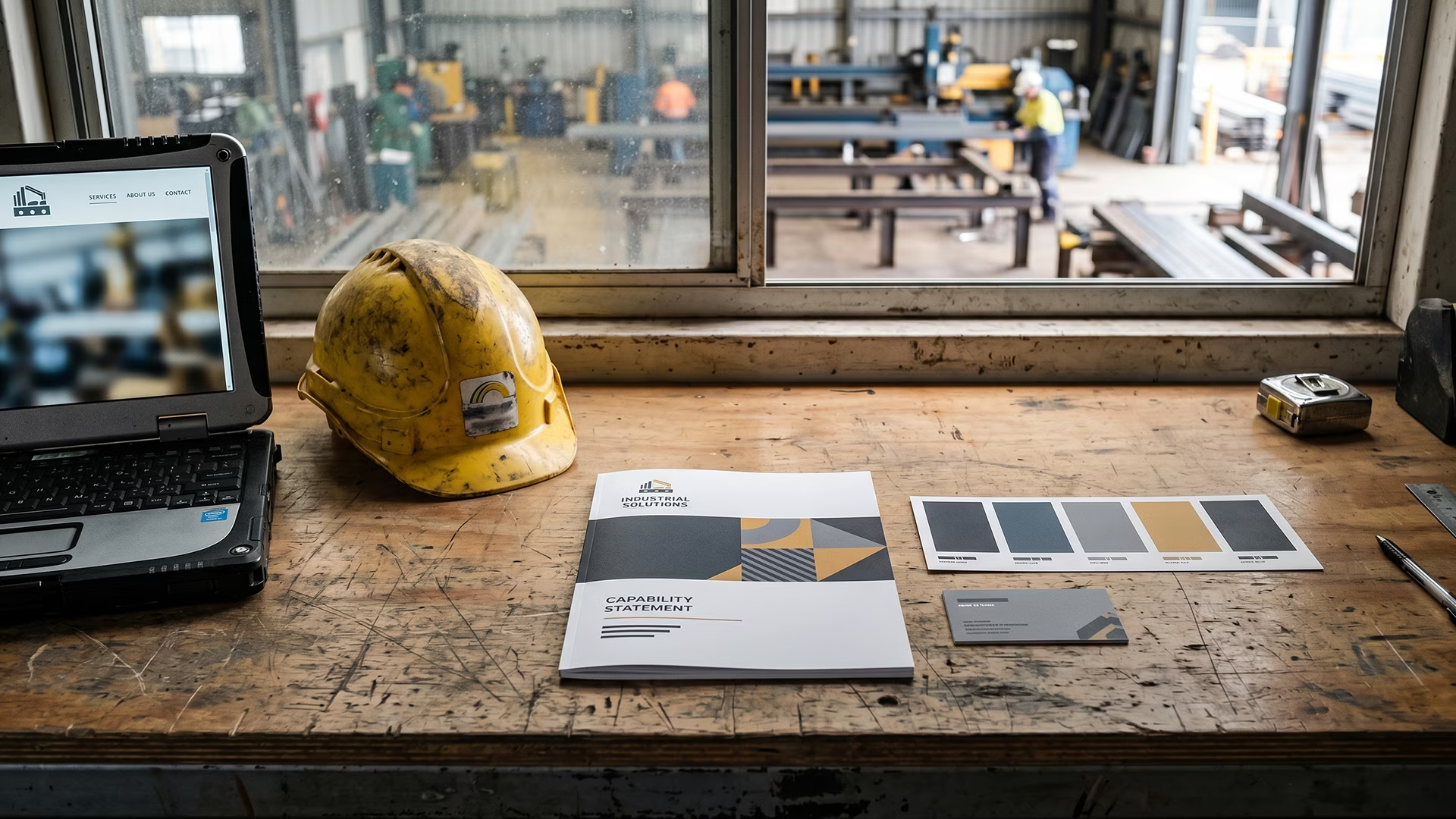
For example, clients might say, "The logo looks dated," or "The website hasn't been updated since 2017." Sometimes, the capability statement is a janky Word doc that's refreshed whenever someone 'gets around to it'.
Yet, in most cases, when a firm expresses the need for a rebrand, the visual aspect is not the true driver. Typically, there are four underlying commercial triggers, which often come in pairs:
- A tier ceiling - The firm is struggling to break through to the next level, losing out on work to competitors with more 'perceived polish' but weaker field execution.
- Leadership transition - This often involves a new general manager or a next-generation family member who views the commercial presentation as a devaluation of the firm.
- Commercial event - This includes a merger, acquisition, private equity interest, or succession plan that exposes the firm's market presence to external scrutiny for the first time.
- Tender loss - A recent bid loss has revealed the disparity between how the firm is perceived and how it performs under procurement pressure.
Key stakeholders often become aware of brand issues through third-party sources. For instance, a trusted advisor might casually mention over coffee, "You need to do something about your brand." However, since brand is typically associated only with visuals and aesthetics, and few connect brand issues to measurable losses, this recommendation often gets pushed aside - ending up as a scribbled note on an ever-growing to-do list.
Then, eleven weeks later, when a Tier 1 RFP arrives, it becomes painfully clear that the disconnect between what the firm is and what it projects has transformed into a commercial liability rather than merely an aesthetic concern.
The rebrand request is the symptom that gets named. The commercial trigger underneath is the one worth diagnosing.
Six questions to answer before you brief a designer or brand agency
Many industrial rebranding briefs are created before a commercial diagnosis takes place. This often leads to a creative scope based on untested assumptions.
To prevent wasting money on a superficial solution, a managing director should take 30 minutes to conduct a self-audit using a sheet of paper. Ideally, this self-audit should then be reviewed with two or three key stakeholders in a 45-minute to 1-hour session.
To assist you on your pathway, I've provided six questions below. They are purely diagnostic, not creative. Each one is designed to unearth the commercial driver behind your branding itch:
- What tier of work are you trying to break into, and what evidence does that tier accept as proof? A Tier-1 principal shortlists on documented capability and risk mitigation, not on nice logos.
- Where does your business development pipeline leak? Is it the top (visibility), the middle (qualification), or the close (commercial terms)? Each leak point demands a fundamentally different fix.
- When your capability statement is forwarded within a buyer's organisation, what does it lose out to? If you can't name the specific competitor and the gap between you, your documentation is doing your job for you - badly.
- Which leadership transition is on the near horizon? Is it on your side, the buyer's side, or both? A new procurement coordinator at a Tier-1 client instantly resets every legacy relationship you have with that account.
- What is the succession or sale horizon for the firm? A three-year exit strategy rewards a completely different commercial presentation than a steady-state operating plan.
- Which named competitor has been winning work you should own? Read their capability statement and website through the cold eyes of a procurement manager. If you can't bring yourself to do it, you already have your answer.
If your answers point toward systemic operational or strategic challenges, the project ahead of you is not a rebrand. It's a commercial rewire with a brand wrapper. For a worked example of that path, see our mining rebrand case study.
Diagnose before you design. Flipping that order is why many industrial rebrands end up being a cash burn.
Cosmetic refresh or a commercial rewire?
Once you have run the self-audit, you face a clear fork in the road. The findings will indicate whether the firm is buying a B2B website refresh or a commercial rewire. Misunderstanding which one you need is how six-figure budgets get burned.
A cosmetic refresh
A cosmetic repaint changes only the visual layer. You get a new logo, a modern colour palette, a slick website, and a polished capability statement. However, your market positioning remains untouched. Your capability evidence remains unproven. Your business development process stays the same. The commercial triggers that prompted the project in the first place are still live and dangerous the day the new website or collateral pack launches.
A commercial rewire
This layer is structural. It starts by rebuilding your positioning: whom the firm serves, what tier of work it competes for, and why it deserves to be shortlisted by a buyer who has never heard of you.
A commercial refresh completely overhauls your capability evidence, transforming documents into data-backed proof of delivery at scale, under real-life conditions. Finally, it aligns your business development process (how you qualify, present, and close). The visual brand layer is then produced last, acting as a wrapper for that foundational work because it now has something substantial to encase and support. That wrapper is what my Foundry - B2B Marketing Plan Execution product delivers once positioning and proof are locked.
The stakes for this choice are high. If you opt for a cosmetic refresh when your audit clearly demands a rewire, the system doesn't fix itself. You will spend a pile of resources on a beautiful new presentation, only to find yourself losing the same tenders to the same competitors twelve to eighteen months later, for the same reasons.
A refresh changes how the firm looks. A rewire changes what the firm is. Confusing the two is what makes marketing expensive.
What a B2B industrial rebrand fixes (and what it can't)
When you approach this as a commercial overhaul grounded in industrial brand strategy and positioning, rather than just a fresh coat of paint, it solves four specific business problems.
Winning bigger contracts. Your work on-site is flawless, but your paperwork has to survive a brutal procurement process. A commercial refresh ensures your track record looks as professional on paper as it is in the field, so you stop getting filtered out early by a checklist you never see.
Protecting your sales team. A good website should do the heavy lifting before the first phone call. It needs to explain exactly who you serve and what you do. This added layer of prequalification stops your team from wasting hours quoting on jobs that are a bad fit and will never close.
Getting top dollar when you exit. If you ever want to sell the business to an investor or a larger competitor, buyers will look for any excuse to chip away at your price. When your presentations look amateurish compared to your actual operation, you hand them an easy excuse to discount your valuation.
Handing over the baton. Whether you are passing the company to the next generation or bringing in an external manager, the business needs to stand on its own feet. This process documents how your company actually wins work, turning your reputation into a system rather than something trapped entirely in the founder's head.
The limits of a new look
A rebrand highlights the genuine strengths your company has built over time, making them clear to potential buyers who might otherwise overlook you. It does not create capabilities that don’t already exist. If you believe that a fresh appearance can substitute for true operational effectiveness, you’ll invest the money, launch the new site, and continue to lose the same contracts for the same reasons.
A rebrand makes what is already true visible. It does not make what is missing suddenly manifest.
The people who can quietly kill (or save) the project
Project plans chart the timeline, but they rarely chart the internal politics. While there are always hiccups along the path to fulfilling on timeline milestones, they are rarely what stalls an industrial rebrand. More often than not, it is the influence of the people on the sidelines that determines whether the project moves at pace or grinds to a halt.
There are typically five key roles that either move the project forward or hold a veto, even if they aren't officially on the project committee:
- The Veteran Ops Manager. Fifteen years with the firm, deep technical pedigree, and runs the day-to-day. If you consult with them late and they push back on the principle that marketing is a distraction from the 'real work', you will run into trouble. Bring them in from day one, however, and they will become an asset.
- The CFO (often second-in-charge to the founder). The translator between new leadership initiatives and the founder's old-school financial instincts. They will back the project when the scope, ROI, and payment structures are crystal clear. They will shut it down the moment an outside consultant tries to bypass them or gloss over the numbers.
- The trusted external adviser. Not on the official org chart or the board, but in almost every major private conversation the founder has. If they read it as just an expensive creative exercise, it is dead in the water.
- The successor or incoming GM. Usually the most active internal champion. They are banking on this overhaul to establish their own credibility and lift the company a tier. Unfortunately, they can sometimes get blinded by the excitement. You will need to ensure their focus stays commercial, not just on making their mark.
- The Business Development Manager. They have been quietly begging for better presentation documents for over two years. The most eager helper in the building, and at the coalface, so they will have a very good handle on what the market actually needs.
Before you hire an agency or a freelancer, map out these players and where they could potentially be standing. Pitch them individually over the next few weeks, so they hear the business case directly from you rather than discovering it via a forwarded email.
Finding out who your roadblocks are in week one is a lot cheaper than running into them in week ten.
How you'll know the commercial overhaul is working
Most marketing measurement is completely useless for an industrial company. Agencies love to report on vanity metrics like website traffic, social media followers, and click-through rates. None of those numbers matters to a procurement manager.
The real proof that your commercial rewire worked shows up on the buyer's side of the table, and it takes six to eighteen months to surface fully. Look for these five operational signals:
Passing the first filter
You start sailing through prequalification processes that used to trip you up. The compliance forms and evaluation criteria haven't changed, but the evidence you submit now satisfies the evaluator immediately, stopping them from filtering you out early.
Better quality enquiries
The companies reaching out to you change. Enquiries start arriving from Tier-1 buyers who already understand your true capacity and scope before they pick up the phone. Your team spends far less time filtering out bad-fit jobs that you never should have been quoting on in the first place.
Harder-working documentation
When your capability statement gets forwarded up the chain inside a client's office, it stands on its own merits. You stop losing momentum mid-sales cycle because the paperwork clearly and independently backs up what your sales team promised.
Unsolicited referrals
Procurement managers start recommending your firm to their peers in rooms you aren't even in. You notice this when high-value enquiries land on your desk out of nowhere, with the buyer already halfway convinced to work with you because your market reputation matches what they have been told.
Bigger initial project sizes
The dollar value of the first conversation changes. Instead of getting shortlisted only for small, low-margin trial packages, clients start inviting you to bid on the major scopes that actually move the needle for the bottom line.
Related reading: my manufacturing marketing case study.
The metrics that look good on a dashboard rarely move the bottom line. The ones that move the bottom line rarely look good on a dashboard.
FAQs
Treat it as a commercial conversation, not a creative one.
The audit output, particularly the positioning and capability statement findings, gives the founder a business case to react to rather than a designer's opinion to defend against.
If the audit shows the existing brand is costing the firm at the tier it's trying to win, the conversation reframes itself.
Spend ranges materially with firm size and current state, but a defensible rewire for a mid-tier industrial firm sits in the mid-five to low-six-figure range across positioning, capability evidence, and visual assets.
The credibility return is immediate at the next prequalification or panel refresh, which is typically three to twelve months out depending on the buyer's cycle.
Run the audit immediately and rebuild the capability statement and positioning before the tender lands.
Skip the full visual rebrand for now; the buyer at this prequalification cares about evidence, not aesthetics. Sequence the visual identity and website refresh into the following six months once the immediate commercial pressure is off.
Describe the work without naming the principal. Commodity, scope, scale (tonnes, metres, contract value, fleet size), site conditions, and the operational problem solved.
A procurement manager recognises the profile even when the client is redacted. Discretion about a current client signals you'll be equally discreet about theirs, which often outweighs the named reference.
Key takeaways
- Many industrial firms have a structural commercial problem that surfaces as a marketing issue. The visible request, a new logo or website or capability statement, is a symptom of a deeper breakdown in how the business positions, qualifies, and converts.
- The four commercial triggers that drive industrial rebrand requests are a tier ceiling, a leadership transition, a corporate event (merger, acquisition, succession), and a tender loss. Yet, the visual symptom is downstream of all four.
- The decision is binary. A cosmetic refresh changes the visual layer only; a commercial rewire changes positioning, capability evidence, and the business development process, with the visual layer as the wrapper.
- A rebrand makes what is already true visible to a buyer who would otherwise miss it. It cannot manufacture salesforce, capital, technical capability, or relationships that haven't been built.
- The people who quietly decide whether the rebrand sticks are rarely on the project plan. Map the Veteran Ops Manager, the CFO who bridges to the founder, the trusted external adviser, the successor or incoming GM, and the Business Development Manager in week one.
- The signals that tell you the rewire is compounding are buyer-side, not dashboard-side: passing the first filter, better quality enquiries, harder-working documentation, unsolicited referrals, and bigger initial project sizes. They take six to eighteen months to surface.